KisanKonnect - Farm-Fresh Groceries, Made a Daily Habit
Turning perishable, farmer-direct produce into something people buy on repeat - not a one-off cart, but a subscription that survives real life.
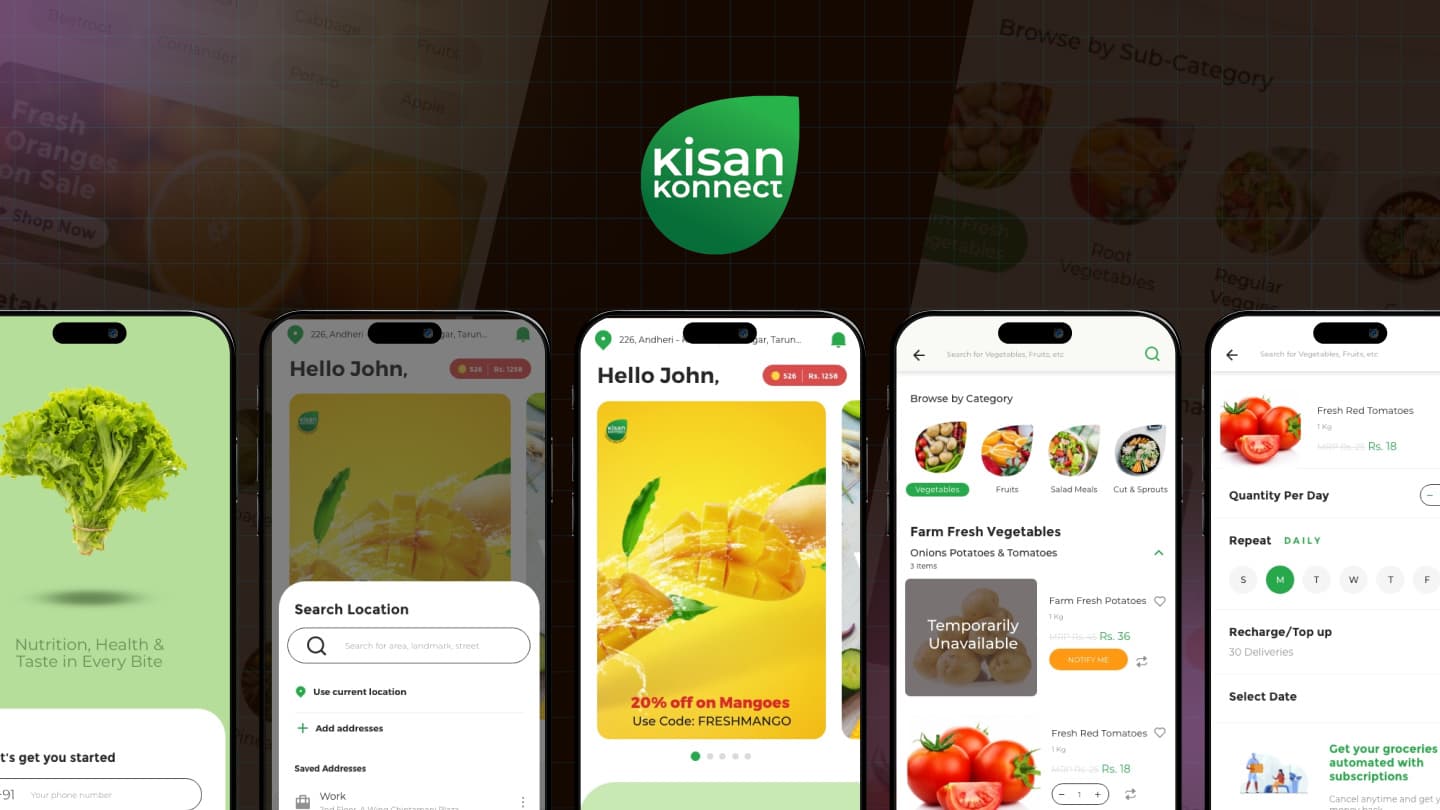
- Role
- UI/UX Designer (end-to-end)
- Client
- KisanKonnect
- Type
- Product · B2C Mobile Commerce (AgriTech)
- Platform
- Mobile app
TL;DR
Most grocery apps are built for a one-time cart: search, add, checkout, done. But fresh produce doesn't work that way. It's perishable (you need it again in three days), price- and availability-variable (weight and rate shift by location and season), hyperlocal (we can only deliver if a farm route reaches you), and farmer-direct (curated fresh, not picked off a shelf). The real design problem wasn't "build another grocery app" - it was: make buying perishable, farmer-direct produce a low-friction habit, and design every seam where the messy reality of fresh + hyperlocal delivery meets a consumer who just wants good vegetables on time.
My role & contribution
- Owned UI/UX end to end as the sole designer, building the product from scratch rather than redesigning an existing app.
- Worked from KisanKonnect's own business requirements (farm-route serviceability, subscription and pricing rules, delivery-slot capacity) to define the product's information architecture.
- Designed the core decision to make subscription, not a one-time cart, the spine of the app, since perishable produce is a repeat purchase by nature.
- Designed the un-glamorous seams a grocery app usually skips: vacation pause and refund, location-aware repricing, and slot capacity, as first-class states rather than edge cases.
Motivation
Most grocery apps are built for a one-time cart: search, add, checkout, done. Fresh produce doesn't behave that way, since it's perishable, price-variable by location, and deliverable only where a farm route actually reaches. Starting from scratch and working from KisanKonnect's own business requirements, the brief was to design for repeat purchase and hyperlocal reality from day one rather than bolt them onto a generic commerce template: subscription as the default path, serviceability checked before effort is spent, and honesty (on price, on slots, on delivery) built into the product rather than left as customer-support cleanup.
The core challenges
- 01Repeat over one-off - perishables need constant re-buying; a standard cart-and-checkout model quietly fails the actual use case.
- 02Fresh is variable - weight, price and availability shift by location and season; the UI has to handle "price changed for your area" honestly.
- 03Hyperlocal gating - we can't serve everyone everywhere; serviceability has to be checked early and kindly, before a cart is built.
- 04Real life interrupts subscriptions - people travel; a subscription that can't pause (and refund) is a subscription people cancel.
- 05Trust in freshness and delivery - buying produce sight-unseen requires provenance, curation transparency, and a visible delivery promise.
- 06Speed for a busy user - discovery, re-add and checkout had to be fast and low-decision; the target user values reliability over browsing.
Design solutions
A subscription engine as the spine, the highest-leverage decision
The single most important design call: make recurring the first-class path, not an afterthought. From a product, the shopper chooses Subscribe or Deliver Once.
Subscribing opens a purpose-built flow: Quantity Per Day, a Repeat selector (Daily or specific weekdays), a Recharge/Top-up balance, and a Select Date start, with the value spelled out plainly: automate your groceries, cancel anytime and get your money back, set vacation days easily. This converts a must-rebuy category from a chore into a set-and-forget routine, the retention engine the whole business depends on.
From choosing to subscribe to a schedule the shopper manages, not re-orders.
Swipe to see the next step →
A customer ends up managing a schedule, not a series of one-off orders, which is what makes a repeat category feel effortless.
Vacation pause and refund, designing for real life, not the happy path
A subscription only survives if it bends to the user's life. Create Vacation lets the shopper suspend all deliveries between two dates, with the consequences stated honestly up front: all subscriptions are extended (they restart when you're back) and any one-time orders in that window are auto-cancelled and refunded.
This is the un-pretty state most subscription products ignore, and getting it right is exactly what earns the trust that keeps someone subscribed instead of cancelling before a trip.
A serviceability gate that respects the shopper's effort
Because delivery is hyperlocal, the app checks whether it can serve you before you build a cart. On entry it asks to share your location to check deliverability, with a manual fallback, and the full toolkit (detect, search, confirm, save multiple addresses) locks the serviceable address in early.
Gating up front is a kindness: it prevents the worst fresh-commerce experience, which is falling for a cart that can't actually reach you.
The path from detecting a location to a locked-in serviceable address.
Swipe to see the next step →
Serviceability is settled up front, not discovered at checkout, because the worst fresh-commerce experience is falling for a cart that can't actually reach you.
Honest, location-aware pricing
Fresh prices move, so the product tells the truth about it, from the first time a shopper sees a price to the moment it might change. Price and unit are stated plainly on the product, because produce is sold by weight and trust, and if the delivery location changes, a clear toast explains that prices have changed rather than silently adjusting the total.
In a category where rates genuinely vary, transparency is the difference between "fair and fresh" and "why did my bill change?"
From the product page to the moment a price actually changes.
Swipe to see the next step →
The cart surfaces savings per item and MRP struck through rather than quietly re-charging a different total.
A cart built for the realities of fresh, hyperlocal delivery
The cart does far more than sum a total, it's where fresh commerce gets handled honestly. It shows a live delivery promise, lets the shopper subscribe to any item inline, and folds in the practical realities: packaging type for perishables, make-this-a-gift, apply coupon/referral, written and voice delivery instructions, a transparent bill breakdown, and a free-delivery threshold nudge.
Every one of these is a small answer to a real fresh-delivery problem: packaging for perishables, finding the doorstep, hitting the free-delivery threshold.
Quantities and substitutions, then the choices particular to fresh goods.
Swipe to see the next step →
Packaging is in the cart, not buried in settings, because for perishables it's a real choice, not a preference.
Delivery slots that admit when they're full
Fresh delivery is capacity-constrained, so slot selection is honest about it. The shopper picks Today / Tomorrow / a future date, then a time window, and windows that are unavailable are shown as "(Slot Full)" rather than failing at checkout.
Setting the expectation at selection time, not payment time, is what keeps a time-boxed fresh order from ending in frustration.
The promise is made real before payment, not after.
Swipe to see the next step →
An honest "no" at slot selection beats a promise the farm can't keep at checkout.
Farm-to-doorstep order tracking, trust as a narrative
Post-order, tracking is designed to build confidence in the fresh, farmer-direct promise. Instead of a generic "out for delivery," the tracker narrates the model: order sent to farmer, farmer curating the best items for you, packing your crate, in transit, at your doorstep, over a live map.
The status steps aren't decoration, they are the brand story, reassuring a shopper who bought produce they haven't seen. Prepaid nudges and a safety note in support (we never ask for bank/UPI details) round out the trust.
What happens after checkout, narrated rather than left silent.
Swipe to see the next step →
The tracker is the brand story, not decoration, reassuring a shopper who bought produce they haven't seen.
Reflection
- The strongest decision was making subscription the spine, not a feature. Perishables are a repeat category; designing for repeat first is what fits the real behaviour - I'd surface the subscribe path even earlier from discovery and instrument subscribe-vs-one-off from day one.
- The un-pretty states are the product. Vacation pause/refund, "prices changed for your area," and "slot full" are where trust in fresh commerce is won or lost - I'd push that honesty into proactive comms when a farm substitutes an item.
- Serviceability gating is a kindness, and I'd make it even earlier and warmer - investing more in the "not yet in your area" moment (waitlist, notify-me) so a non-serviceable user still leaves with a good taste.
- The farm-to-doorstep tracker is underrated brand equity. Narrating "the farmer is curating your crate" does more for trust than any marketing copy - I'd extend that storytelling into the product and post-delivery experience.
Visuals are recreated / sanitised representations for portfolio use and contain no real client data.